In corporate strategy consulting, the "benchmark replication trap" is not rare. Huawei's IPD process is held up as the gold standard for R&D management, yet it pushed one EV start-up into an organisational coordination bottleneck. Matrix structures help leading companies carry out complex business portfolios, yet those who copy them often run into rigid departmental silos. Behind these cases lies an easily overlooked pattern: the effectiveness of an organisational model is never the result of a single variable.
Recently, the organisational change controversy at that start-up and the continued growth of Anker Innovations form a pair of contrasting cases well worth studying. The first introduced a Huawei-style organisational system and found it did not fit; the second adopted a similar IPD and matrix model and achieved clear results. At the heart of the difference is not the merit of the management tools themselves, but the underlying fit between the founder's temperament, traits and the organisational strategy. This is the core variable that determines the effective boundaries of an organisational form, though not the only one: industry cycles, resource endowment and team DNA also play a part. This article focuses on that core variable, examining in depth how the founder's temperament influences strategic choices and the implementation of organisational models.

The start-up's mismatch:
a product geek against a rules-led organisation
The difficulties that start-up encountered when introducing Huawei's three-dimensional matrix organisation stemmed fundamentally from a divergence between the founder's traits and the ecological soil this model needs. This was not the only cause, of course. At the time, the start-up was in the critical phase of expanding from a single model to a matrix of several models, and the twin pressures of vehicle development and channel build-out had already added to the organisational load. On top of that, the smart-driving team was moving from "purchasing plus integration" to in-house development, and was wrestling with internal friction. These specific, stage-related problems amplified the inherent conflict between the founder's traits and the model, but the former remained the most central internal driver.
From an automotive internet platform to an EV start-up, the founder's core capability label has always been "product geek plus strong central decision-maker". His concrete insight into user needs and his meticulous control of product experience underpinned the start-up's differentiated breakthrough in the new energy sector. These traits naturally suit a "founder-centred" organisational structure, in which a core decision layer anchors the strategic direction and each function executes efficiently around it, forming a short, closed loop from decision to delivery.
By contrast, the core precondition for a Huawei-style matrix organisation is that the founder has the traits of "philosophical and scientific thinking plus rules above all". The management logic Ren Zhengfei built centres on "process above the individual", using institutional design to keep power running in an orderly way within a framework of rules, such that even the founder is bound by the organisational system. This organisational model needs not a "super product manager" but an "organisational ecosystem builder". It requires the founder to give up some decision rights voluntarily and move the company from "individual-driven" to "system-driven".
The deeper conflict lies in the cognitive differences created by their paths to growth. This founder's entrepreneurial experience centred on the direct link between "product and users", without systematic experience of running a complex organisational ecosystem. He is used to deciding quickly on the basis of personal insight, whereas a matrix organisation requires "programmed cross-departmental operation": from breaking down requirements and allocating resources to executing processes, every step depends on institutional support rather than the authority of an individual. When the founder's "fast-decision gene" collides with the organisation's "process gene", mutual friction is inevitable: the organisational system constrains the speed of decisions, and individual decisions break through the boundaries of the system.
This also explains why Huawei-style matrix organisations are rarely replicated successfully in Chinese companies: most founders build their capability base in business breakthroughs or resource integration, and entrepreneurs who genuinely have the core capability of building organisational systems are scarce to begin with.

Anker's fit:
an engineer CEO in resonance with the IPD system
Anker Innovations applied the same IPD process and matrix organisation, and its success was the result of several factors resonating together. At the heart is the natural resonance between founder Steven Yang's "engineer's mindset plus data-driven traits" and this management system. External conditions, such as the traffic dividend in the early years of overseas expansion and the mature supply chain base of the Pearl River Delta, provided the soil for that fit to take root. Steven Yang's traits not only suit the organisational model; his capability endowment also improved the path by which it was implemented.
Strategic anchoring: the shallow-sea strategy as a rational extension of his traits
Steven Yang chose to "avoid deep-sea categories such as smartphones and computers and focus on shallow-sea markets such as charging and energy storage". This was not simply a judgement on competitive landscape, but a precise awareness of how well his own traits matched the strategy.
As a former senior engineer at Google, Steven Yang's core capability is "data insight plus iterative optimisation", traits that better suit shallow-sea markets with clear demand and short technology cycles. Competition in shallow-sea categories depends not on the boldness to "bet right on an industry trend", but on the precision to "mine segmented demand through data and build a moat through incremental technological innovation". This aligns closely with the "algorithmic optimisation thinking" Yang excels at, turning an engineer's rational analysis into market competitiveness.
And the "many categories, small batches, fast iteration" nature of the shallow-sea strategy gives the matrix organisation a natural use case. Each segmented category needs coordinated responses from R&D, marketing and the supply chain, and a traditional line-and-function structure struggles with such dynamic resource allocation. This gives the matrix organisation "strategic legitimacy", making organisational change the necessary choice to support business development, rather than simple benchmark imitation.
Implementation: rebuilding the IPD system through an engineer's logic
Steven Yang did not copy Huawei's complex IPD architecture. He built on his own traits to make a "lightweight rebuild", creating an implementation path with Anker's own character:
Data-driven processes: defining management rules with algorithmic thinking. Yang built Google's data analysis logic into the management system, breaking the full product development process into modules that are "quantifiable and traceable". In the core IPD step of requirement review, for example, Anker does not rely on experience-based judgement. An AI system consolidates data from more than 20 million user reviews worldwide to build a scoring model for requirement priority, supporting decisions with "data in place of intuition". This way of working matches an engineer's pursuit of "certainty" and fundamentally avoids personal interference from relationships in process execution.
Platformised capability: dual middle platforms supporting matrix flexibility. Drawing on Huawei's experience in building middle platforms, Anker built a dual-platform system of "technology platform plus the three-pillar HR model". Steven Yang led the creation of "Laboratory 2023", gathering three to four hundred core technical staff to focus on foundational technologies such as battery management and multimodal sensing, forming a reusable "shelf of technical capability". When the UV printing business began its transformation, 60%-70% of core technology modules could be called on directly, safeguarding the flexible response of small frontline teams while avoiding duplicated investment in technical resources. The three-pillar HR model, meanwhile, divides the work into "business partners embedded at the front line, centres of expertise delivering solutions and shared services handling transactions", solving the common pain point in matrix organisations where human resources support lags behind business needs.
Mechanised collaboration: breaking down departmental silos through shared interests. The core governance challenge of a matrix organisation is that "departmental interests take priority over overall goals", and Steven Yang solved it by redesigning how interests are distributed. He introduced a "7:3 value distribution between labour and shareholders", allocating 70% of the enterprise's surplus value to employee incentives. He also set up the "Stellar Innovation Plan", which sets aside 8% of net profit each year as a dedicated fund to support any employee with a feasible innovation proposal. These mechanisms align closely with Yang's value of "growing together", moving cross-departmental collaboration from "passive cooperation" to "active co-creation".
Course correction: the organisation and the founder's temperament evolving in step
The "systemic growth bottleneck" Anker hit in 2022, in fact, confirmed how a founder's temperament calibrates an organisation. At the time, nearly 20 of its 27 product lines saw sales decline, its 3D printer business was significantly overtaken by the competitor Bambu Lab, and the root cause was that "the organisation was expanding faster than culture and capability could permeate it".
Steven Yang's response did not reject the matrix model. Instead, he went back to his own "first principles" trait. After working through the core logic during a period of retreat, he decisively cut non-core businesses such as pet products and electric bicycles, trimming the product lines to 17. He also upgraded the company's values to "first principles, striving for excellence, growing together", asking teams to shed reliance on experience and return to the essence of the business. In essence, this adjustment realigned the organisational form with the core of the founder's temperament, and by 2025 it delivered a rebound, with the UV printing business setting a global crowdfunding record.


The YUNLUE view:
a model for matching founder traits with organisational strategy
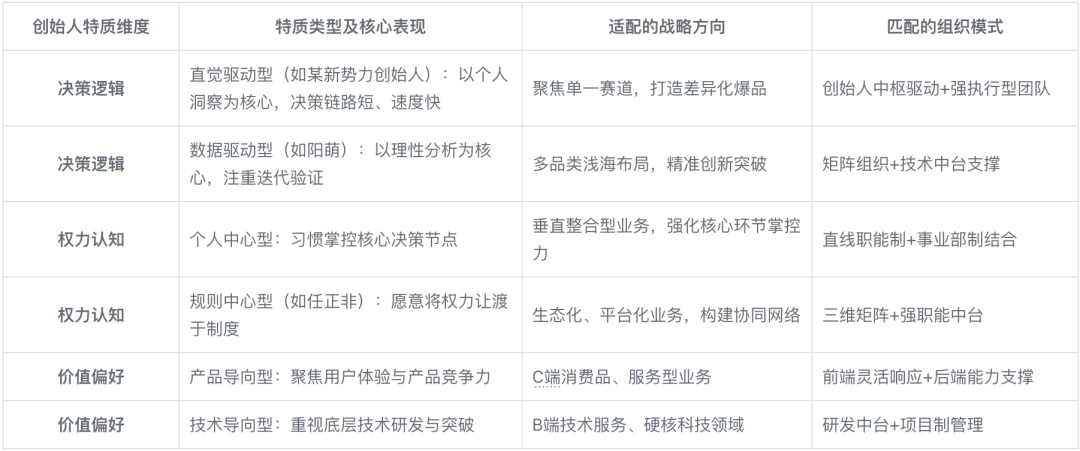
The cases of the start-up and Anker reveal the anchor role a founder's temperament plays in the fit between organisation and strategy. It is not the only influencing factor, but it sets the basic DNA of the organisational model. In YUNLUE's consulting practice, we usually build a matching framework from four dimensions: "founder traits, strategic direction, organisational model and external environment", with founder traits as the central thread:

Conclusion:
resonance between the organisation and the founder's temperament
The contrast between the start-up and Anker shows clearly that there is no universally valid "best organisational model", only the "best solution" under a multi-dimensional fit of "founder traits, strategy, organisation and environment". Huawei's matrix organisation is not a standard answer, and Anker's IPD implementation is not a template that can be copied directly. Both are the result of a core variable working alongside supporting factors, in which the founder's temperament is the most critical "key to fit".
For founders, the first precondition of organisational change is not benchmarking, but completing a dual diagnosis of "my own traits and the external environment": do you rely on intuition or on data? In the exercise of power, do you prefer control or rules? Is the industry a red ocean or a blue ocean of opportunity? Can the resource base support organisational transformation?
The essence of organisational change is to move the company from "the founder's personal capability" to "organisational system capability". The core precondition of that shift is resonance between the organisational form and the founder's temperament, not a single-variable fit that ignores the other factors. When founder traits, organisational form, strategic direction and the external environment form a multi-dimensional force, a company can truly make the leap from "opportunity-driven" to "capability-driven" and build a core competitiveness that is hard to replicate.