I am Jolly from YUNLUE Consulting. Every year I lead a team that delivers more than 30 senior COE and HR roles, and I have seen a great many COE candidates whose salary stalls at RMB 800,000, as well as a good number of cases that broke past RMB 2 million. What I have found is that the key difference usually lies not in depth of expertise but in distance from the business.
What is more, over the past year AI has become an increasingly capable assistant on some of the basic work of a traditional COE, such as building a policy framework or drafting a compensation analysis report, and in some scenarios the quality of its output has reached the level of a mid-level professional.
A CHO once said to me, half joking: from now on, when you headhunters put a COE forward, you will first have to prove that AI cannot do what he can.
I have also found that the more senior the COE, the less they fear AI, because they stopped earning their living by drawing diagrams a long time ago.
This is not alarmism. When basic professional output can be replaced by machines at low cost, what is left of a COE's core value? In this article, I want to use a few real cases to discuss a deeper problem I have observed: many COE hires from outside fail not because their expertise is lacking, but because they were put in the wrong position from the very start.
One of my "failure cases"
In 2023, I helped a consumer company with an annual revenue of RMB 5 billion find a COE for compensation and incentives.
The profile from the head of HR was clear: "big-company background, experience with a complete job-grade system, good at long-term incentives." I followed it to the letter, put forward 3 candidates, and the one who joined was the one from a big company at P8+.
The final interview went smoothly. The boss asked three questions: "What systems have you built?" "How do you see our current incentive problems?" "How do you plan to go about it once you are here?" The candidate answered without a single gap. The boss was satisfied, and so was HR.
Six months later, the person had left.
The head of HR told me: "His proposals were beautifully drawn, with flawless logic, but the business simply would not accept them. The business head said 'we can't use this thing', and the boss felt that all that money had produced no change."
In the review we found that the failure had multiple causes, including organisational inertia and the new hire's integration strategy. But from the recruitment side, a common problem is that the boss tends to want the big-company halo and the business unit wants someone who can fight from day one, so the profile easily turns into "we want this, and that, and the other".
I dug out the original interview notes and found a fatal blind spot:
the boss only asked "what systems have you built", never "how would you get the business head to want to use your system"; only professional capability was tested, not the ability to survive.
This is not an isolated case.
Over the past two years, the YUNLUE HR function team has tracked 47 COE hires from outside, 24 of whom (51%) left or "fell short of expectations" within a year. Looking back, in the great majority of cases the root cause was not professional capability but a gap between the profile set before the hire and the real needs of the business.
Companies want someone who can land things, yet they hire to the standard of someone who draws diagrams.
More noteworthy still, a growing number of organisations are pushing COEs out to the business frontline, and COE-BP has become the new standard. That places new demands on the COE capability model: they must not only draw diagrams but understand the language of the business. This is not something that can be solved simply by "sitting over there".

Today, from the perspective of a headhunter specialising in HR functions for more than 6 years, I will break down three questions and talk about the truth behind failed COE hires from outside:
01
The root of COE failure:nearly 70% is a "profile mismatch", not a lack of expertise
I have worked on more than a hundred COE roles and found that every successful COE is different, but failed COEs share one thing: they were hired to the standard of a "system designer" and then asked to do the job of a "problem solver". Put more directly: the problem is not the person; the role profile and the real need do not match.
These are the three most common profiles we see in our work:
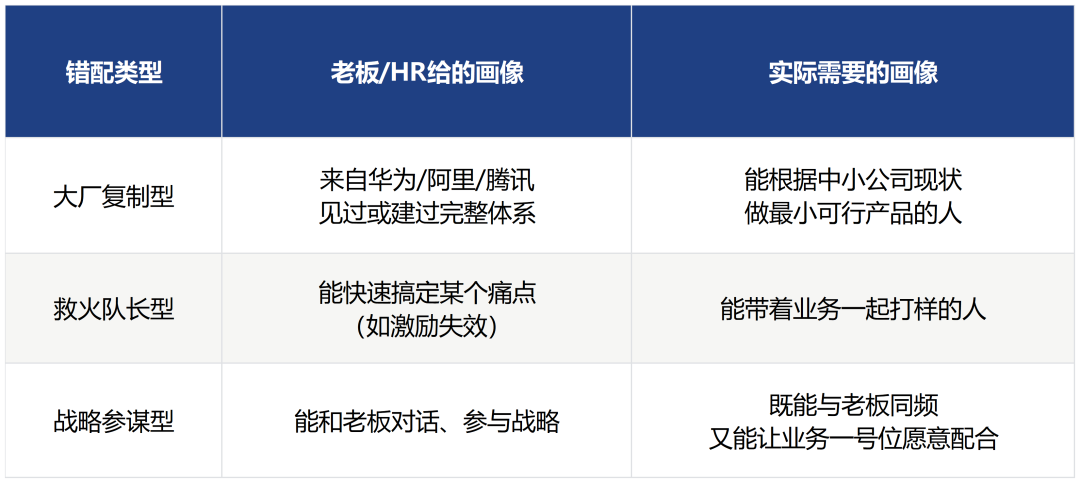
Why does this happen? I have observed two reasons. First, clients are attached to the idea of a system, always believing that once a perfect set of policies is in place the organisational problem is solved. Second, there is time pressure in hiring: when the profile is vague, the easiest compromise is the big-company halo. The result is a person hired against beautiful-looking standards who is painful to actually use.
One of my "success cases"
Last year a client needed a head of talent development. The first profile from HR was the same old formula: "big-company background, has built a competency model, has run talent reviews, can build a pipeline".
I did not rush to put people forward. Instead I asked four questions first:
What is the biggest pain point on the talent development side right now?
Answer: the plans cannot be implemented.
Why can't they be implemented?
Answer: the business leads are unwilling to take part in talent reviews and see them as a waste of time.
What do you want this person to have solved within three months of joining?
Answer: first of all, the problem with talent reviews.
Can someone from a big company who has built a model definitely get the business on board?
Silence...
In the end I recommended a COE from a mid-sized company who had also spent 2 years as an HRBP. In the interviews and the background check, one key characteristic kept showing up: every time he ran a talent review, he went into the business unit himself and ran it alongside the directors, rather than just issuing a template. After joining, he got the review running within the agreed timeframe, and the business directors felt that "this is actually useful, he isn't here to make trouble for me".
02
When recruiting a COE,the 3 selection mistakes bosses and HR make most often
Even with the right profile, many companies still make basic mistakes in the selection process, screening out the right people and bringing in the wrong ones.
Below are three "selection blind spots" I have observed repeatedly when helping companies recruit COEs:
Mistake 1: testing only "professional capability", not "the ability to translate into business terms"
Typical sign: The candidate is asked to present their proudest project, and explains it fluently: which model they used, how they designed it, what results it delivered. But nobody probes further: did the business cooperate at the time? How did you persuade them?
Where the problem lies: A COE's expertise is visible, but the "translation capability" that gets the business to cooperate is an invisible lifeline. A missing answer here may be a warning sign that the person lacks the habit of turning professional terminology into business value.
One method I have tried with very good results: Add a role-play segment to the interview, in which the candidate faces a real business head (or HR plays the part) and explains a professional proposal on the spot, such as a job-grade reform or a pay adjustment. Watch whether they use jargon or the language of the business. Answering purely in jargon may mean they are not yet used to communicating in business terms, whereas a response such as "this change will let your department hire faster and retain people more reliably next year" would be more ideal.

Mistake 2: in the final interview the boss talks only about impressions and never about landing scenarios
Typical sign: The boss asks "what have you done, and how do you see our problems", the candidate answers beautifully, the boss thinks this person is capable, they get on well, and the decision is made on the spot.
Where the problem lies: The boss treats the interview as a chat rather than a simulation of a real scenario. Someone who can charm you over dinner cannot necessarily face down the doubts of 3 directors in a business meeting.
I usually suggest that the head of HR align with the boss on the interview focus beforehand, and ask the boss to pay attention to these four questions:
Which module do you plan to tackle first in your first 90 days, and why that one? (tests prioritisation)
If the business head says your proposal is out of touch with reality, what will you do? (tests handling of conflict)
What do you need me, the boss, to do to help you drive this? (tests resource awareness and upward management)
If there is no visible change in the business in the first three months, how will you prove to me and the team that the direction is right? (tests stage-by-stage review and expectation management)
These questions filter out candidates who can only draw diagrams and cannot land anything. I once saw a candidate answer the third question like this: "I need you to spend 10 minutes at the monthly business meeting backing me, telling the business heads 'this is decided, you need to cooperate'." The boss immediately felt that "this person knows how things work". That candidate joined smoothly and integrated into the team.

Mistake 3: background checks that only ask the "former boss" and never the "former business partner"
Typical sign: HR calls HR at the candidate's previous company, hears that "this person is very capable and left for personal development", and passes them. Or the headhunter only spoke to the candidate's direct manager and never to the business side.
Where the problem lies: A COE's real influence is not inside the HR department but in whether the business side wants to use their proposals. The view of a former business partner very often reveals how the candidate actually performed in driving things across functions and landing them, and is a critical supplementary perspective.
When I run a background check, I insist on one thing: finding the business leader the candidate once worked with, and asking three questions:
Have you used the proposals he put forward?
How did they work out? Do you have a specific example?
If you had to do it again, would you still want to work with him?
I once saw a candidate whose former boss described him as "very strong professionally", while the former business director said "we rarely used his proposals, because they were too complicated". We did not put that person forward.
03
Hiring the right person is only the first half:on integration, there is something headhunters can do to help
We have discussed the profile and the selection process, but hiring the right person is only half of success. The other half is integration.
From "delivering CVs" to "delivering outcomes", the YUNLUE team has long insisted on extending its service beyond the start date. Without overstepping and managing on behalf of HR — after all, the main players in integration are the candidate and the company. Our distinctive value is that, alongside precise matching, we can provide support at key points during the critical integration stage, so that a new hire moves from merely arriving to genuinely belonging.
We have found that in many companies the logic of using people is: "we have hired them, they should know how to survive on their own". The reality is that the first 90 days after a COE joins from outside are the most fragile and most easily cut short: information asymmetry, distrust from the business, and a boss with no time.
We do 3 things to give that a nudge:
Before the start date — clear the information blind spots: What are the boss's decision preferences? Why did the previous COEs fail? Which business head is the hardest to deal with? This information keeps the candidate from making a "blind landing".
First month — establish a communication rhythm: We suggest that the head of HR, or the boss when the boss also serves as CHO, hold at least one 1:1 each week in the first month, each lasting more than an hour. At the same time, clarify three key questions, one quick win and the plan for the next 90 days.
At key points — act as a third-party translator: When the boss complains that "he's been here two months and nothing is moving", we do not act as a relay. We ask: "When was the last time you had a 1:1 with him? Have you clearly told him what you most want to solve?" Sometimes the problem is not the candidate, but that the boss has not given enough time and authority.
I once handled a case like this. Before the candidate joined, I arranged for him to have a meal with a core member of the client's former COE team, planting a cognitive anchor on the business pain points in advance. In his second week, he did just one thing: he simplified the long-winded talent review into a single A4 sheet, which the business directors completed in only 30 minutes. Because it was genuinely useful, the director became his internal champion and spread the tool across the whole company. One quick win earned him three months of room to make mistakes.
We have come to see more and more clearly that what a headhunter really delivers is not a CV, but a higher probability that a person will grow steadily within an organisation.

A final word
The value of a headhunter has never been filling holes. It is precise matching plus continuous follow-through on integration.
My team and I are not here to push the most expensive person to you, but to find the person best suited to the current state of your organisation: identify them, bring them in and stay alongside them until they have integrated and taken root.
Finally, a question for everyone who has read this far:
COE-BP and HRBP both serve the same business unit. Who is the main player and who is the supporting one?
There is no standard answer to this question. What matters is that the organisation defines clearly how the two collaborate in specific scenarios and who leads, so that overlapping responsibilities do not lead to buck-passing or conflict.
I am Jolly from YUNLUE. You are welcome to add me on WeChat and talk.

《 Recommended reading 》
Career advice: the candidate who left a Fortune 500 company and fled within three months