1. A textbook executive hire: a values match that delivered effective collaboration
In 2014 Tesla faced severe challenges in the Chinese market: sluggish sales growth, limited brand awareness and slow progress on charging infrastructure. Tesla then made a key decision that became the turning point for its China business: hiring Tom Zhu as President of Greater China.
Several senior executives inside Tesla have said that Tom Zhu is an "Eastern mirror" of Musk's values. That deep fit showed not only in the execution of strategy, but was rooted in every layer of thinking, innovation and identification with the mission.

2. Musk and Tom Zhu: five dimensions of converging values
Seen through the lens of deep matching in executive selection, the close fit between Tom Zhu and Musk fundamentally comes from the perfect resonance of his inner drive and key abilities. It shows not only in agreement with ideas, but in every concrete decision and action:
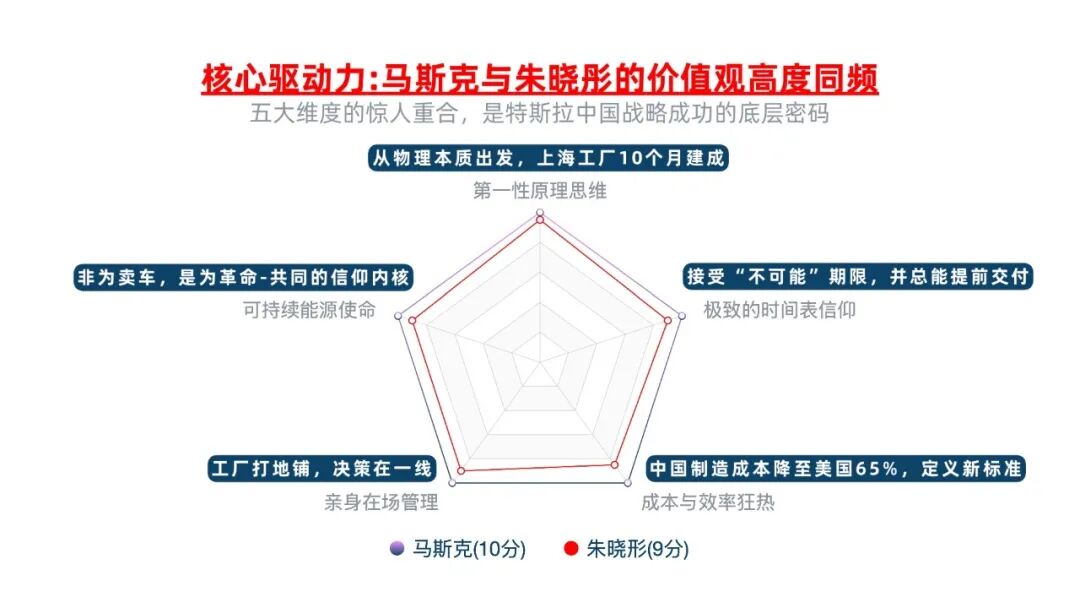
1. Strong resonance on "first-principles" thinking
The first-principles thinking Musk advocates went, in Tom Zhu, from a fundamental way of seeing things to outstanding execution. When Tesla decided to build a plant in China, conventional thinking held that it would take at least 3-4 years. Tom Zhu started from the essence of the problem and, drawing on his deep insight into the Chinese market and industry, rebuilt the path to a solution. In the end the Shanghai Gigafactory achieved an industry first: construction started, production began and deliveries were made all in the same year.
Internal evidence: according to the Tesla internal management memorandum (the 2020 leaked version), Musk praised Tom Zhu at several executive meetings for "profoundly understanding how to apply first principles to Chinese realities".
2. A shared faith in "impossible timelines"
Musk is known for setting "near-impossible" timelines, which requires executives with intense achievement motivation and outstanding organisational leadership. Tom Zhu not only accepted the challenge wholesale, but organised "24-hour, three-shift" operations and drove cross-departmental joint efforts to turn pressure into extraordinary execution. That strong identification with the "impossible", and the creative way it is delivered, reflects the unity of his core values and exceptional leadership.
3. A shared pursuit of cost control and extreme efficiency
Behind this lies a closely shared ranking of values: continuous optimisation that does not sacrifice long-term innovation. Tom Zhu took Musk's cost-control philosophy and, through professional operating capability, developed it into a localised "vertical integration" model for China. The Shanghai plant cost 65% less to build than its US counterpart, and the production cost of the Model 3 fell by a further 30%. These are quantifiable results of inner motivation combined with professional innovation.
According to the Tesla China Supply Chain White Paper: the integration strategy Tom Zhu introduced was a plan Musk had long championed but struggled to implement fully in the US, which shows his outstanding ability to localise and land head-office strategy.
4. A perfect match of the "being there in person" management philosophy
This is both a leadership style and the outward expression of a deeper value: a belief in the power of deciding on the ground and staying in step with the team. During the construction of the Shanghai plant, Tom Zhu practically lived on site, and his leadership by example markedly raised the team's commitment and speed of execution, demonstrating the core leadership ability to mobilise a team to overcome difficulty.
5. A sincere belief in the mission that goes beyond commercial interest
Several former Tesla executives have noted in their writing that what Musk values most is whether an executive truly believes in the mission to "accelerate the world's transition to sustainable energy". Before joining, Tom Zhu was already an early user and advocate of electric vehicles, and his inner motivation and beliefs were pure. He stressed repeatedly internally: "We are not selling cars; we are driving an energy revolution." That deep identification with the mission allowed him to hold his strategic resolve under enormous pressure, and to turn it into the team's lasting fighting spirit and execution.

3. The distinctive management advantages and value that converging values create
[Figure 1: Core drive: the closely aligned values of Musk and Tom Zhu]
Sources: the biography Elon Musk, public Tesla board and executive evaluation documents, and Bloomberg and Reuters interviews with former Tesla executives
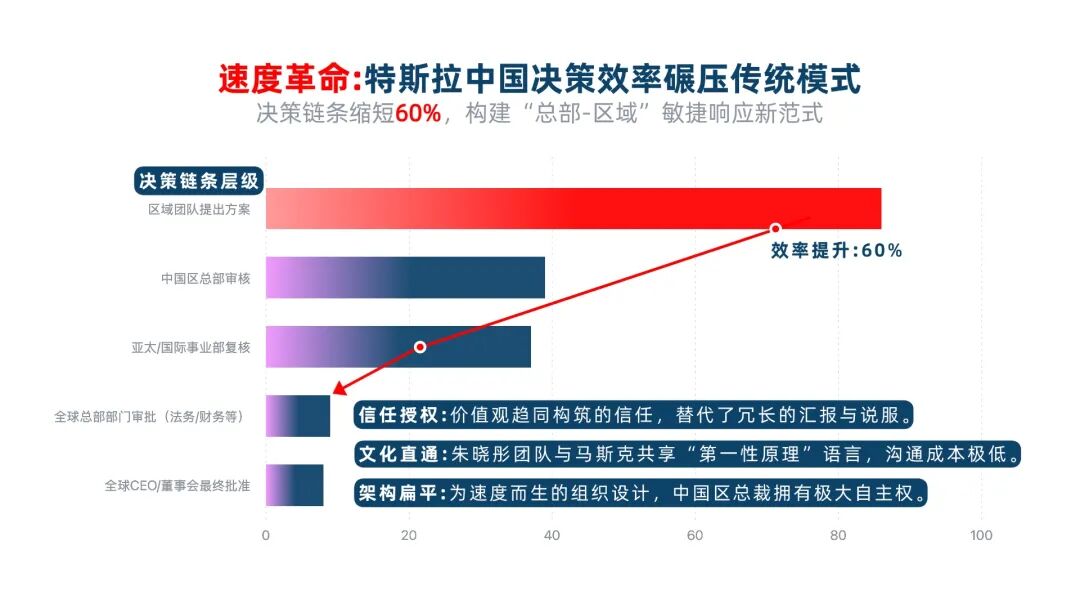
[Figure 2: The speed revolution: Tesla China's decision efficiency versus the traditional model]
Sources: McKinsey's Automotive Industry Organisational Agility Report, and public cases such as the construction of the Tesla Shanghai plant and localised OTA updates
[Figure 3: Exponential growth: the transformation of Tesla China's revenue, 2014-2024]
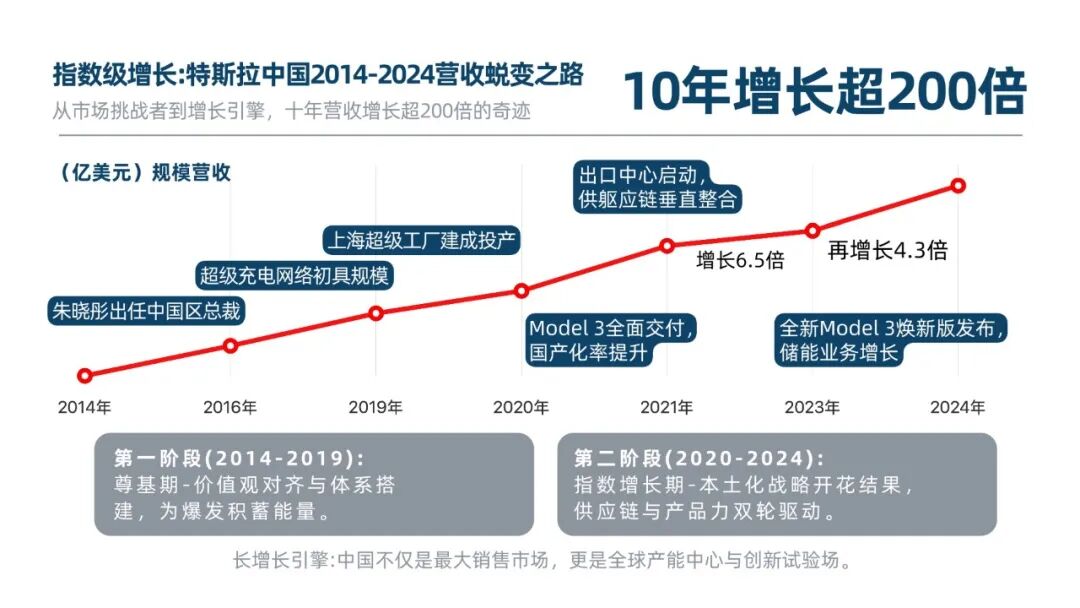
Sources: Tesla, Inc.'s annual reports filed with the US Securities and Exchange Commission (SEC) from 2019 to 2023, financial data terminals such as Bloomberg and Refinitiv, and Tesla outlook reports published by Morgan Stanley, Goldman Sachs and other institutions between late 2023 and early 2024

4. What internal assessments reveal about the depth of the fit
In interviews with former Tesla executives (collected in a 2022 Bloomberg Businessweek feature), several key figures put it this way:
Greg Reichow, former Vice President of Global Production at Tesla, said: "Of all the regional leaders I have worked with, Tom is the only one who made me think, 'this is what Musk would do if he were in China'. He is not imitating; he is thinking from the same underlying logic."
Sarah Zhang, former legal counsel for Tesla Asia-Pacific, recalled: "In one dispute over supplier selection, Tom chose the more expensive but more innovative option. When questioned, he said, 'which one would Musk pick?' and the issue was settled. That consistency of thinking is more powerful than any KPI."
Walter Isaacson, author of the Musk biography, found in his research that Musk divides executives into two groups: those who understand his philosophy and those who do not. Tom Zhu not only understands it, but can develop and apply those principles in the Chinese context.

5. How converging values translate into a leap in performance
This close alignment of values brought decisive advantages in the actual business:
1. Accumulated trust capital: Tom Zhu was given far more autonomy to decide than the head of a typical multinational's China operation, because his decisions "predictably match the way Musk thinks".
2. Maximised communication efficiency: the misunderstandings and explanation costs common in the "head office to region" relationship at multinationals were avoided.
3. Cultural consistency: the "Tesla culture" that formed in the China team closely matched the global head office, reducing cultural conflict and internal friction.
4. Consistency in crisis response: when facing supply chain crises and public relations challenges, the China operation's response stayed closely aligned with global strategy.

6. Spotting the "standard-bearer" precisely: a methodology for putting like-minded executives at the centre of growth
By now, we hope you can see that in executive hiring, values fit matters well beyond the traditional dimensions of capability and experience. What really drives organisational breakthroughs and long-term growth is often the deep fit between a candidate and the company's core leaders in their underlying thinking, identification with the mission and logic of behaviour. In practice, companies should systematically strengthen their ability to assess and identify an executive's "values fit":
1. Values can be identified: structured in-depth interviews, scenario-based case analysis and multi-dimensional background research can effectively reveal whether a candidate's decision logic, ranking of values and sense of mission are in tune with the founder or core leadership. Before joining Tesla, Tom Zhu had already expressed, through public remarks and career choices, his identification with innovation and sustainable energy. Signals of this kind can be captured and assessed early in the hiring process.
2. Values can be verified: values show not only in words, but throughout past key decisions and patterns of behaviour. During hiring, companies should focus on analysing a candidate's past projects, how they handled crises and their long-term career trajectory, to verify the consistency and authenticity of their values.
3. A values match creates superlinear returns: when an executive and a company are closely aligned at the level of core values, communication and trust costs fall substantially, the precision of strategy interpretation and execution improves, and a synergy takes shape in crisis response, innovation and culture building, delivering organisational outcomes where 1+1>2.
4. The value of the "cultural adapter" role: executives whose values align can often serve as a cultural bridge between head office and a regional market, rather than merely executing tasks or relaying policy. They can respect the local context while ensuring that the global mission and cultural core are neither distorted nor lost.
So how do you assess the fit between an executive and a company more fully?
Drawing on more than 10 years of executive search experience and its track record of having served 400+ leading and mid-tier Chinese privately owned enterprises and placed over 2,000 executive talents, YUNLUE Consulting has distilled a "DNA double-helix model" for identifying core senior talent with precision. The model stresses that outstanding executives need a deep fit between two helixes, Drive and Ability:
Drive: covering cognitive patterns, the core of values, motives and needs, this determines "what the candidate is fighting for" and the deeper logic behind their behaviour.
Ability: covering trend insight, organisational command and professional competence, this determines "how the candidate can deliver" and their ability to solve problems and mobilise teams in complex environments.
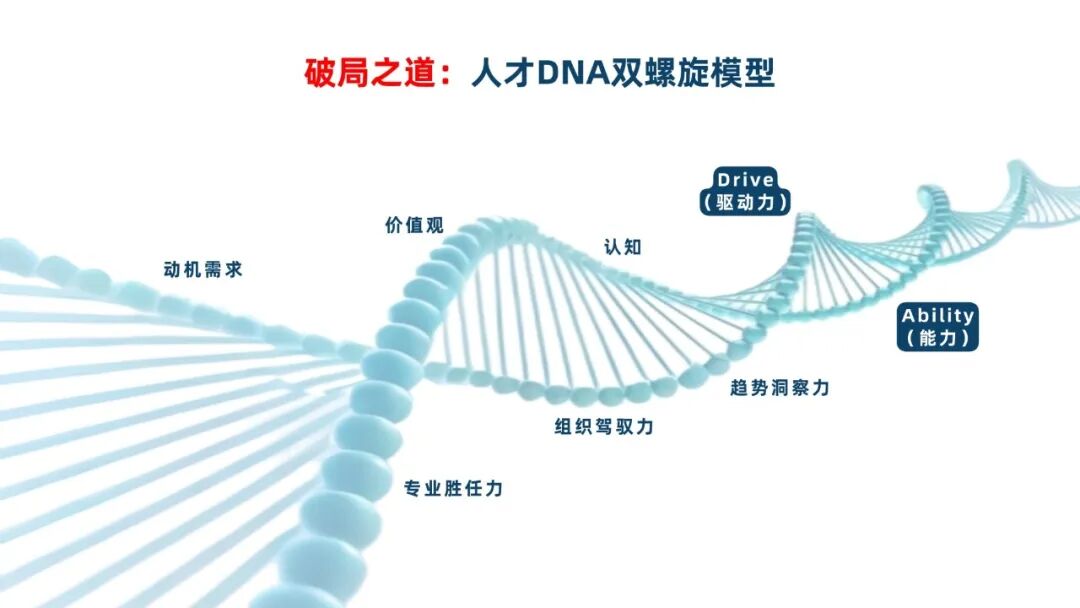
To assess the "accuracy" and "depth" of a candidate's DNA, YUNLUE has honed two key methods in practice:
Method one: structured exploration that sees past appearances. Through several rounds of structured in-depth conversations between experienced consultants and the candidate, we probe not only professional knowledge and experience, but look beneath the surface to understand the thinking framework, value judgements and subconscious motives behind the candidate's decisions, and map their true drive.
Method two: multiple perspectives to verify consistency. Through cross-validation from former colleagues, subordinates, superiors and business partners, we go beyond fact-checking to understand how consistent the candidate's behaviour is across different working relationships and pressure situations, along with their interpersonal style and true character, giving a three-dimensional confirmation of both capability and how they live out their values.
Of the five dimensions of the "values alignment" between Musk and Tom Zhu, which one struck you most or felt most thought-provoking? If you are a manager, which quality would you most want your own team to have? We would love to hear from you in the comments.