The latest industry research shows that around 73% of family business leaders in China plan to hand management control or ownership to the next generation within the next five years. The figure points to China entering the largest transfer of family wealth and business control in human history. Whether succession succeeds affects not only the rise and fall of individual companies, but also the innovative vitality of China's private economy and the continuity of its social capital.
Most people assume that the fate of the handover depends on whether the second generation is clever enough, has an impressive enough education, and is capable enough. We are used to focusing on the successor as an individual, expecting a perfect heir with all-round ability.
The truth is far from what most people think. In the case examined below, a seemingly trivial dispute over a CNY 5,000 monthly pay rise concealed a worry that shrank a 400-person company to 30 people within three years, laying bare a fatal flaw in the succession process. YUNLUE analysed 253 family businesses that have gone through succession and distilled 3 core truths that determine a smooth handover. More importantly, faced with the inherent difficulties of succession within the family, handing the business to a professional manager has become the way some of the best family businesses break the deadlock. Midea Group's handover of power to Fang Hongbo is a model case: the mechanisms behind it complement the experience of family-internal succession, and together they form an effective path for Chinese family business succession.
1. The problem is not a lack of ability, but an absent mechanism
Truth one: what brings a company down is not a spendthrift heir, but a cognitive mismatch after dropping straight into the top
Boyu's story is typical. An overseas graduate, he took over the media company his father founded at its peak, with more than 400 employees. Within just three years, the company shrank to 30 people. The final straw came when a core director resigned. This veteran of a full ten years with the company moved to a competitor, and the offer that won him over was simply CNY 5,000 more per month.
Boyu could not make sense of it at all. He went to the HR director and asked, baffled:
"Lao Zhou, what is going on with this guy? I always treated him like family, I respected him and made allowances for him in everything, and yet he goes to a competitor over CNY 5,000 a month? Not even a little loyalty?"
This is a textbook "parachuted successor" failure. Because he went straight into the core management team, he lacked the most valuable thing of all: a feel for frontline reality. That director left not simply for money, but to secure proof that his value was recognised. He had built his business from scratch alongside the founder, taking it to nearly CNY 1 billion in annual revenue, yet his pay had only been adjusted marginally in the past three years. The CNY 5,000 was an emotional outlet for his professional worth. Boyu, who had never been through systematic training, could not understand such a complex human need. He saw only a cold number.
The first underlying principle here is that the core risk in family succession is not a successor who lacks ability, but a founder who has failed to build a mechanism that lets the successor, whether a family member or a professional manager, gain experience and earn managerial legitimacy. Any "parachute" who has not been through frontline induction, however impressive the background, is bound to come in for a hard landing. This applies to family heirs and equally to externally hired professional managers. Without a systematic mechanism for onboarding, development and binding, even a top-tier professional manager will struggle to integrate deeply with the company. Today this high-risk "parachute succession" model, covering both family heirs and external professional managers, still accounts for 10-15% of cases in China.
2. The real gap is not in the people, but in the system
Truth two: successful succession paves the road rather than handing over the seat, and the effective path is not limited to succession within the family; professional manager succession can also be delivered through systematic design
The failed succession at Boyu's company stands in sharp contrast to the steady handover at Fuyao Glass and the professional manager succession at Midea Group. When Cao Dewang developed his son Cao Hui, he used a logic of "systematic paving" to reinforce the foundations of family-internal succession. When Midea founder He Xiangjian passed the baton to professional manager Fang Hongbo, he built a framework of "institutional empowerment plus long-term binding" that set a benchmark for professional manager succession. The two cases follow different paths, but both confirm the core principle that the system decides the outcome of succession.
Fuyao Glass's family-internal succession mechanism breaks down into three core components:
Frontline development: Cao Hui did not parachute in. He started at the most basic shop-floor post, rotating through production, sales, management and other core functions. This "revolving door" development gave him a deep understanding of the company's underlying business logic and the real demands of its employees, and gave him the frontline feel that future decisions would require.
Professional support: during the rotation, Cao Dewang gave Cao Hui "dual mentors". Internally, seasoned veterans showed him the way and helped him integrate into the company culture; externally, a professional consulting team provided systematic coaching on his knowledge gaps, filling blind spots.
Sound governance: a professional board of directors was established so that major decisions are made with collective wisdom rather than one person's subjective judgement. This not only develops the successor's decision-making ability, but also gives the company a safety net against the chain reactions a single mistake can set off.
The professional manager succession at Midea Group is the benchmark case for the separation of ownership and management in a Chinese private enterprise. Its core system also has three pillars, drawn from the same logic as Fuyao but along a complementary path:
Long-term development and verification of capability: Fang Hongbo did not take the baton as a parachute. He started as an editor of Midea's internal publication and rotated step by step through market, sales, business unit management and other core posts, proving his ability continuously in real work. In particular, during the critical strategic transformation of 2011, the "quality and efficiency improvement" reform he led delivered clear results and laid a solid internal foundation of legitimacy for his eventual succession. This path of "growing inside plus verification in practice" replaced the "natural identity" of a family heir as the core foundation on which a professional manager builds managerial authority.
Interest binding and incentive compatibility: He Xiangjian drove the introduction of an employee shareholding scheme and a management buyout at Midea, so that the core management team led by Fang Hongbo became shareholders of the company (as of the end of 2024, the management team represented by Fang Hongbo held a combined personal stake of approximately 2.26%). Through a "business partnership" mechanism, the personal interests of professional managers are deeply bound to the long-term development of the company, breaking the classic dilemma of professional managers chasing short-term gains.
Modern governance and checks on power: He Xiangjian led the creation of a modern corporate system with a separation of powers among shareholders, the board of directors and the management team, together with a family constitution stating that members of the He family would not take seats on the board and would not interfere in the running of the business. This governance design gave Fang Hongbo full operational autonomy, while creating checks through a professional board and external independent directors. It gave the company an institutional safeguard that goes beyond dependence on any individual.
Together these two cases, one of family-heir succession and one of professional manager succession, reveal a common lesson: what decides the fate of succession is not the identity of the successor, whether a family member or a professional manager, but whether an effective "succession system" has been built. A failed succession crudely hands over the CEO "seat"; a successful one builds a "system" that keeps developing qualified leaders and keeps the business running steadily, whether those leaders come from inside the family or from the ranks of professional managers.
This leads to the second underlying principle: the essence of succession is "the passing on of a mechanism", not "the passing of a position", and still less "the continuation of bloodline". A successful founder paves a road the company can walk steadily, rather than simply tossing the key to the finish line to a particular individual.

3. Breaking the succession deadlock: build the mechanism so that the handover lands smoothly
For a family business to succeed through succession, the core task is to build a three-in-one succession mechanism of "development, support and governance". This framework is universal. It applies to developing family heirs and can be adapted to the characteristics of professional managers. Drawing on the complementary experience of benchmark cases such as Fuyao Glass (family-heir succession) and Midea Group (professional manager succession), together with YUNLUE Consulting's own practice, we have refined and upgraded a "three-stage mechanism building method" that gives family businesses a clear implementation plan covering both paths.
1. Trial stage (1-2 years): build a "frontline development plus identity adjustment" mechanism to lay the foundations
The core goal at this stage is to give the successor, whether a family heir or a professional manager, a true understanding of the business, breaking the limits of theorising on paper while building internal identity. The mechanism centres on "immersive rotation, mentor coaching and identity adjustment design".
Rotation design: the scope of rotation must cover core frontline functions such as production, sales, customer service and talent management, with a rotation period of no less than 3 months in each post, so that the successor genuinely gets to the front line and builds hands-on feel. The design should differ by successor type. For family heirs, the focus is on using rotation to break down a sense of entitlement and to build a basic understanding of the business. For professional managers, especially those hired externally, an additional "cultural integration post" should be added to accelerate their understanding of the company's values and internal rules of collaboration, avoiding a cultural divide.
Mentor coaching: everyone is paired with "dual mentors". A senior internal veteran acts as business and culture mentor to help with integration, while an external professional consultant provides systematic coaching on knowledge gaps, such as the commercial practice skills of a family heir or the cross-industry understanding of a professional manager.
Identity adjustment design: for family heirs, the focus is to guide the shift from "descendant of the owner" to "manager of the enterprise". For professional managers, real project-lead roles give them the right to try and fail, while internal briefings and participation in core meetings raise their standing in the organisation.
2. Parallel stage (2-3 years): build a mechanism of "authority and responsibility binding, supported decision-making and compatible interests" to advance capability
The core at this stage is to move the successor from "executor" to "person accountable", sharpening decision-making ability through real work while using mechanisms to manage risk and bind interests.
"Dual helm" authority and responsibility mechanism: the first generation and the successor lead a specific business module together, with the successor's decision rights and responsibilities clearly defined (for example, business development and team management). The successor takes primary responsibility for decisions, while the first generation retains the right to check and to correct. For professional managers, an additional "schedule of authorities and responsibilities" can be signed to avoid later ambiguity over the boundary of power.
Decision support mechanism: a professional board and a think tank are established, comprising seasoned internal managers, external industry experts and consultants. Major decisions by the successor must first go through collective discussion and assessment. At this stage Midea Group's "separation of powers" governance model can be put into practice in earnest to strengthen the quality of decisions.
Assessment and interest binding mechanism: a unified assessment system centred on "business results, team stability and long-term value" is established, strongly linking metrics such as revenue, profit, retention of core talent and R&D investment to performance. Binding arrangements are also tailored to the type of successor. For professional managers, long-term incentive tools such as equity incentives and profit-sharing plans (for example, Midea's MBO plan) should be put in place at the same time to build a "business partner" relationship and break the short-termism trap. For family heirs, assessment results can be linked directly to equity inheritance entitlement and to progression in managerial authority, strengthening their sense of responsibility and long-term thinking.
3. Solo stage (3 years and beyond): build a mechanism of "system renewal and governance optimisation" to sustain development
The goal at this stage is for the successor to move from "beneficiary of the mechanism" to "optimiser of the mechanism", establish their own managerial authority and drive the company's continuing evolution.
System diagnosis and renewal mechanism: the successor leads a "system optimisation group" that works with an external consulting team to diagnose the company's decision mechanisms, talent system, process standards and more. Family heirs can focus on innovating while preserving the legacy; professional managers can focus on efficiency gains and market-oriented transformation (for example, the digital transformation Fang Hongbo led at Midea).
Governance improvement mechanism: the professionalism and independence of the board are further strengthened, external independent directors are brought in, and the supervisory board's functions are improved, forming a closed loop of "decision, execution and oversight". In professional manager succession, the priority is to protect operational autonomy and to define the boundary of power between family and management team through legal documents such as a family constitution and shareholder agreements (see the Midea family constitution). In family-heir succession, the priority is to avoid one-person rule, using governance mechanisms to constrain decision-making behaviour.
4. Not "cannot take over", but "do not want to": the growing range of succession paths
Truth three: when first-generation founders worry about whether their successors are capable enough, the real crisis is that no one is a good fit, and professional managers are an important complementary path
While founders are broadly anxious about whether their children "can take over properly", a deeper and more counter-intuitive crisis has already emerged. According to YUNLUE research on 253 companies (covering both family-internal succession and professional manager succession), as many as 90% of founders hope their children will inherit the family business, yet only about 40% of the second generation clearly express a willingness to take over. The heart of the problem is shifting from "capability" to "willingness".
So where do the second-generation members who decline to take over actually go? Their choices and motivations reveal a profound generational shift.
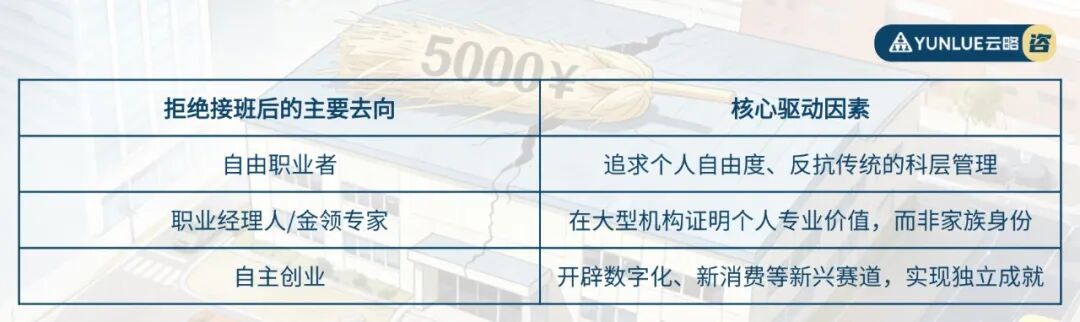
This is not simply youthful defiance or rebellion. Behind it lie deep generational conflicts in values and an "industry gap" between the businesses their parents built and the interests of the younger generation. The first generation usually made its fortune in traditional industries, while their children, educated at elite institutions, are drawn far more to fields such as technology and finance. Forcing them to take over a traditional industry that is "hard, tiring and dirty" is little short of torment. This diversification of ambition goes beyond the world of business. A fair number choose fields driven purely by interest, such as the arts and scientific research, or seek stable social impact in the public sector, which further underscores their departure from a single path of inheriting an industry.
This leads to the third underlying principle: the "succession crisis" can perhaps be redefined as an opportunity. For first-generation founders, the real challenge may not be how to "force" their children to inherit the old business, but how to carry forward the family's wealth, resources and spirit through professional, platform-based structures. Succession paths should by nature offer multiple options. For family heirs who are willing and well suited, build them through a system of "development, support and governance". For those who are unwilling or unsuited, take a leaf from He Xiangjian: build a modern corporate system, select and bind excellent professional managers, and achieve the twin goals of a sustainable business and growing family wealth.
For example, a family office can be set up to manage family capital so that the second generation can focus on investing in new sectors that interest them, while sound corporate governance and incentive mechanisms allow professional managers to lead the ongoing development of the original business. In this way, the meaning of "succession" is upgraded from "inheriting a company" to "managing family resources and continuing value across a range of forms".

Conclusion:
Successful family business succession is never the instant act of handing over power. It is a long, careful process of institution building that embodies top-level wisdom. Its core foundation is neither the blood tie of the successor nor individual gifts, but whether the founder has built a modern corporate governance system capable of self-renewal, one that can develop and select qualified leaders (of whatever lineage) flexibly according to the needs of the business. Family-internal succession and professional manager succession are not opposing options, but two paths under that same system.
For leaders of family businesses today, the core understanding of succession therefore has to be raised to a higher level. The question should no longer be limited to the individual level of "are my children capable of taking over",
but should turn to a systemic review: "can the governance system I have built continue to develop and support qualified leaders after I step away (whether from the family or from the professional management team), and safeguard the long-term, sustainable development of the business?"
First, select external advisers and independent directors who fit the needs of succession precisely. There is no need to pile on numbers; what matters is a professional closed loop and value alignment. A board of 5 to 7 members with 2 to 3 external members is enough, and they should cover strategic planning, risk control and the integration of core resources. For the core pain points of a company in succession transition, prioritise a corporate governance expert, a figure of industry standing and a business reinvention expert. For the first, a former Board Secretary or senior consultant with listed-company experience is suitable; for the last, the profile should match the direction of the company's technology upgrade or business transformation through succession. At the same time, balance cross-sector perspective with value fit, so that homogeneous thinking does not rigidify strategy, and make sure these members respect the family's succession goals while upholding governance rules.
Second, define the boundaries of authority and responsibility, and strengthen decision support and the independence of oversight. A "schedule of authorities and responsibilities" should set out the remit of external members, focused on the core risks of the succession period (such as a break in the handover of management control or a serious decision error). An agenda pre-review system should be established, with major succession-related proposals submitted 15 days ahead of time together with expert assessments. Key committees such as audit and nomination should be led by external members, with clear rules for exercising the right to dissent, giving succession decisions an objective and professional independent perspective.
Third, design "value-binding" incentive schemes that break the short-termism trap. Rather than relying on pay alone, design a range of incentives that reflect the long-term nature of succession. Equity incentives and long-term profit-sharing plans can bind the interests of external members closely to the outcome of succession and long-term development. An assessment system should also be built around "smoothness of succession, effectiveness of risk control and long-term value growth", so that external input genuinely strengthens family business succession rather than becoming a formality.
From the "three-stage development mechanism" inside the family to the empowerment of professional governance from outside, the core of family business succession is always the systematic construction of mechanisms. YUNLUE Consulting will continue to draw on its practical experience to help family businesses open up both paths, internal cultivation and external empowerment, so that succession moves from a high-risk ordeal to a strategic opportunity for upgrading the business.